Building the Institutional Architecture for a Demand-Led Workforce Ecosystem
Partner: Government of Uttar Pradesh | Invest UP
As Uttar Pradesh emerges as one of India's fastest-growing investment destinations, ensuring that talent systems evolve alongside industrial growth has become a strategic priority.
STEP Foundation is working with the Government of Uttar Pradesh to design and operationalise a statewide talent architecture that aligns investment, industry demand, education, skilling, and employment through institutional coordination.
At the centre of this effort is the Kaushal Connect Cell (KCC) - a dedicated institutional mechanism embedded within Invest UP that translates investment commitments into workforce planning and coordinates action across government, industry and training institutions.
Rather than responding to skill gaps after they emerge, the KCC enables the state to anticipate workforce demand, strengthen talent supply, and continuously improve the responsiveness of the skilling ecosystem.
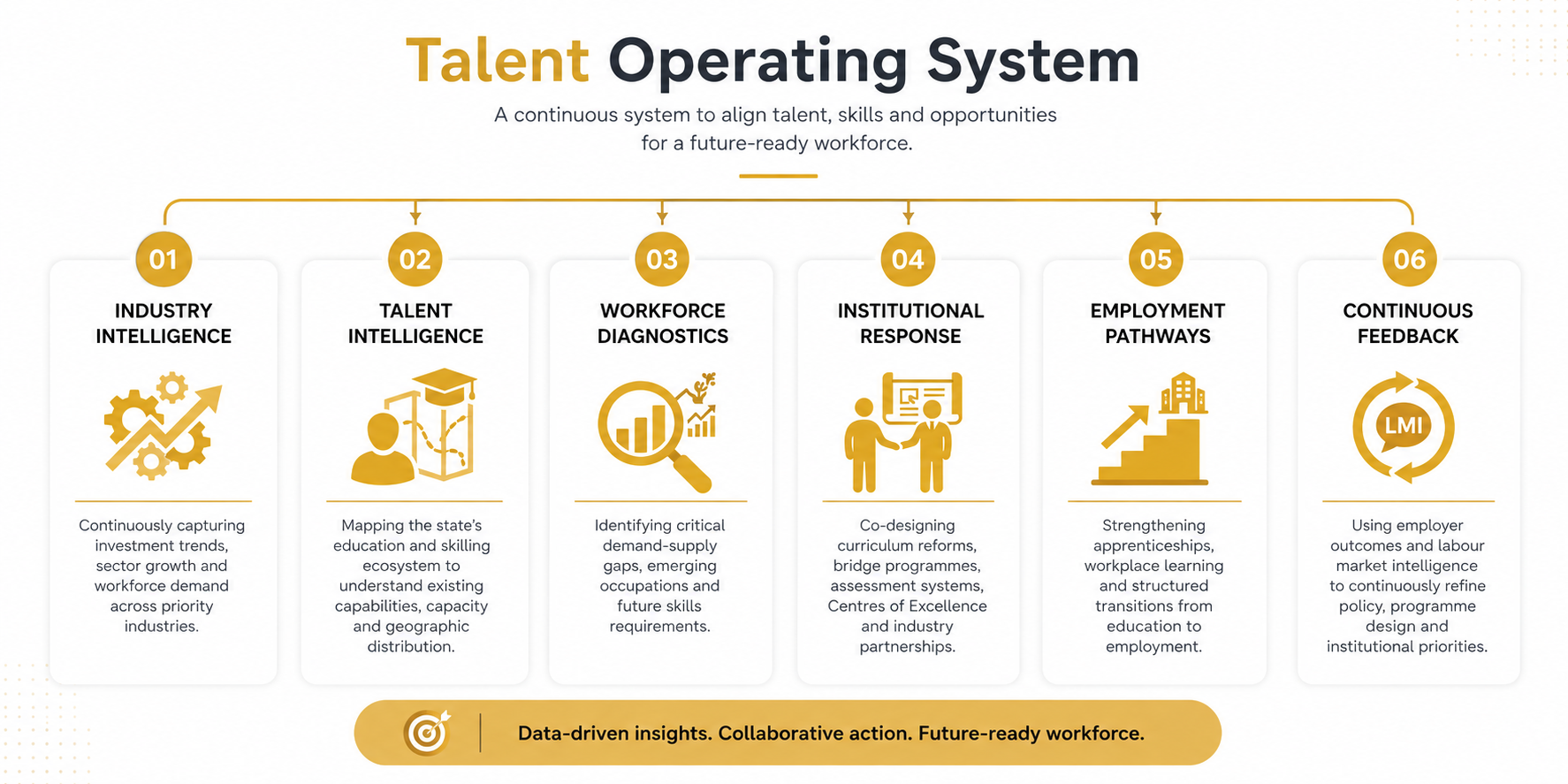
Building the State's Talent Operating System
The Uttar Pradesh model is designed around an integrated, evidence-driven cycle that institutionalises workforce planning rather than treating it as a one-time exercise.
Beyond a Pilot
The Uttar Pradesh initiative is not designed as a standalone project.
It is being developed as a replicable institutional model that enables states to build demand-led talent systems capable of responding to changing economic priorities.
The long-term vision is to establish an integrated workforce ecosystem where investment promotion, industrial policy, skilling, higher education and employment function as a coordinated system rather than independent programmes.
An independent, credible assessment system that works for both industry and candidates — delivered through NCVET-accredited Assessment Centres.
Assessments-on-Demand: Any candidate. Any trade. Any NSQF level. Preferred location. No mandatory training enrolment required.
Gold Certificate: Issued by the Assessment Centre, not the training institution. Nationally recognised mark of competence. Tells employers what a candidate can do, not where they studied.
End-to-end process: Assessment Centre Recognition → Assessor Verification → Candidate Books AoD via SIDH Portal → Independent Assessment → Gold Certificate Issued → Industry verifies digitally → Hired with confidence, no additional trade test needed.
Status: Pilot design and implementation with NCVET underway. Field visits to ITIs completed. Industry consultations in progress.
Workstream 1 — PM-NAM: Three scenarios designed for MSDE: Unified Portal (federated architecture), Joint Governance (national steering committee), Full Institutional Convergence (MSDE-led). National reform roadmap delivered. Input to NITI Aayog's Apprenticeship Act report provided.
Workstream 2 — MSME Pilot Strategy: Three-pillar approach (Awareness, Technology, Incentives). MSME workshop insights captured. GTO/cluster-based models prioritised. Kudumbashree pilot in Kerala: 3 districts, 3.3K SHG enterprises, 13K apprentices, 8+ sectors — with Sambhav Foundation, WorkSetu, LabourNet.
Workstream 3 — State Hiring Pilot (UP): Dixon pilot (May 2026): 190 hires from 345 attendees (55% conversion). Repeatable hiring playbook being built for scale.
Job Data Lab vision: STEP as the ecosystem anchor that integrates India's fragmented labour market intelligence.
Phased approach: Phase 1 (assess ecosystem) → Phase 2 (pilot methodologies) → Phase 3 (institutionalise intelligence into routine skilling planning)
District Demand Planning (MSDE-commissioned): Piloted in Baghpat (UP) and Bharatpur (Rajasthan). 4-pillar framework: Demand, Supply, Training Infrastructure, Institutional Mechanism. Phase 1 landscape scan complete — strong buy-in from district administrations secured.